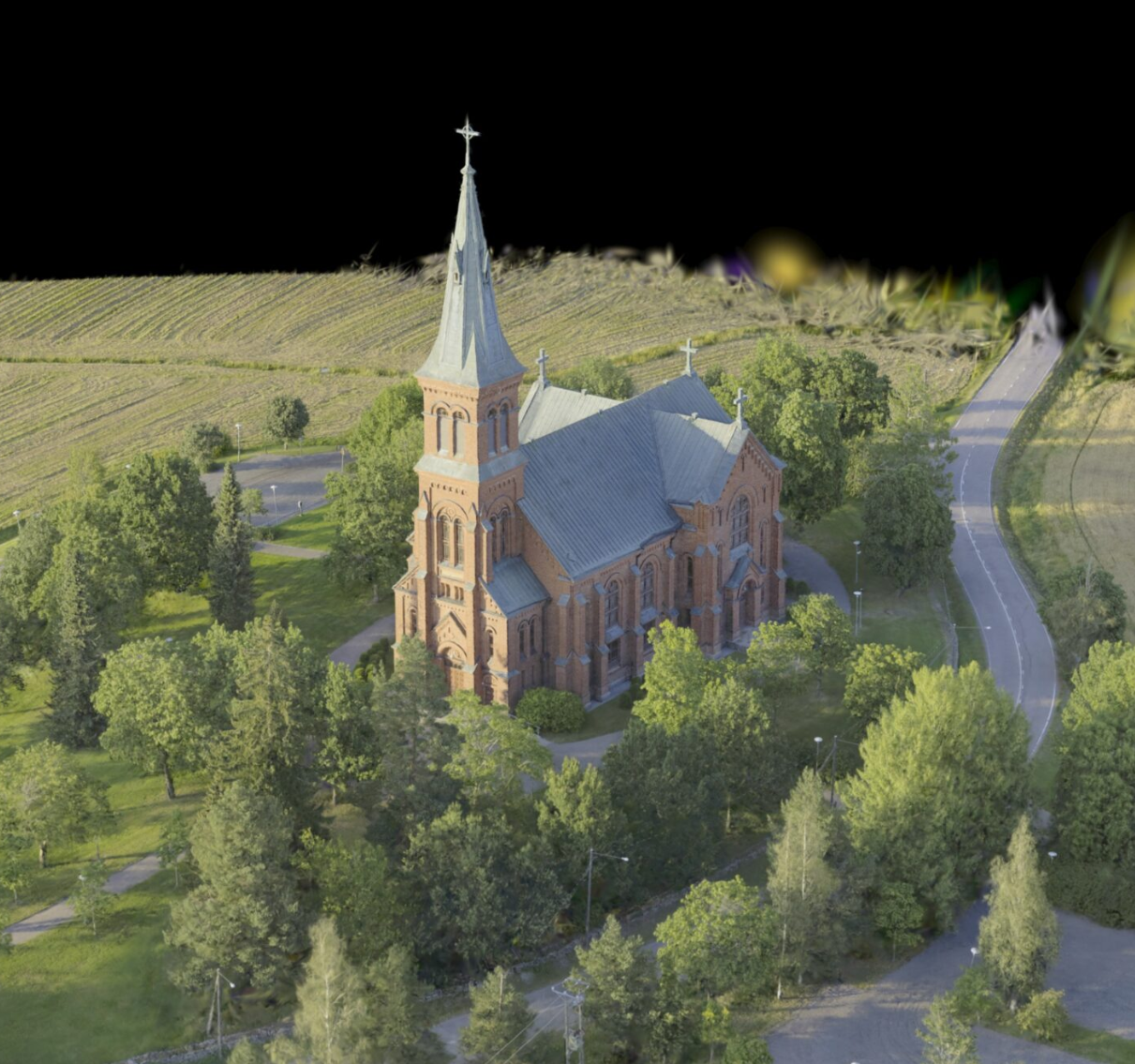
TerraSplat brings photorealistic 3D Gaussian Splatting directly into Bentley and Spatix CAD environments, so your point cloud and reality capture workflows gain a new, more lifelike layer of visualization without leaving the platform you already use.
What TerraSplat does inside your CAD environment, and what that means for your team's day-to-day workflow.
Photorealistic, real-time 3D representation of real-world environments, a step up from both point clouds and mesh models.
3D Gaussian Splatting (3DGS) represents a step change from traditional photogrammetric point clouds, replacing discrete points with smooth, continuous, photorealistic scenes.
Traditional point clouds render discrete points in space. 3DGS instead represents each sample as a semi-transparent colored 3D ellipsoid, producing a smoother and more continuous visualization of the captured environment.
Compared to mesh models, Gaussian Splats better represent delicate or complex objects such as fences, foliage, and other semi-transparent or finely detailed structures. They also capture reflections and transparency accurately, depicting materials like glass and water in a far more realistic way.
Thanks to GPU acceleration, tens of millions of Gaussian Splats can be rendered in real time, giving your team high performance, interactive visualization rather than a slow, static render.
Used on its own, TerraSplat reads .PLY files containing Gaussian Splats and displays them in their correct spatial projection inside Bentley and Spatix. Paired with TerraScan, it becomes a complete LiDAR and reality capture visualization workflow, giving your team both the geometric precision of LiDAR and the visual fidelity of Gaussian Splatting in a single CAD session.
This is especially valuable for teams already running TerraScan classification and modeling workflows who want a richer visual layer for stakeholder reviews, digital twins, and site documentation, without switching software or exporting data to a separate viewer.

Quad-core processor or better, good processor frequency
16 GB RAM minimum, 32 GB RAM or more recommended for larger projects.
An NVIDIA graphics card is required for TerraSplat. VRAM requirements scale with project size, larger splat datasets need more GPU memory.
1024 x 768 resolution or better.
SSD or other fast-access storage recommended for smooth loading of large splat datasets.
Windows x64, version 7 or later.
Spatix
MicroStation CONNECT Edition
PowerDraft CONNECT Edition
OpenCities Map CONNECT Edition
ContextCapture Editor CONNECT Edition
OpenRoads Designer
Geospatial solutions for surveying and mapping professionals — hardware, software, and field-tested workflows.
Want more information?
1520 Clay Street
Kansas City, MO 64116
© 2026 Vertical Aspect LLC. All Rights Reserved.